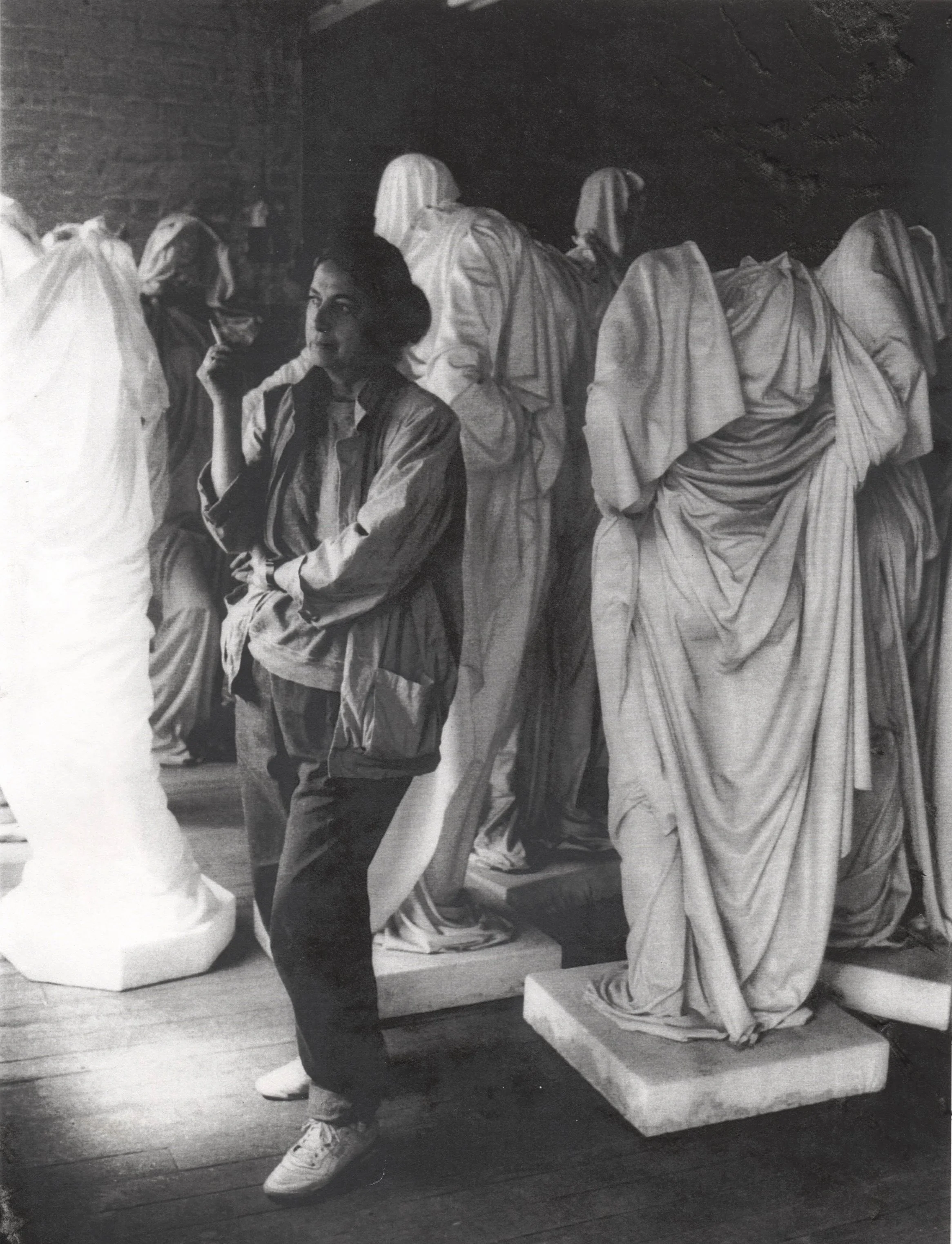
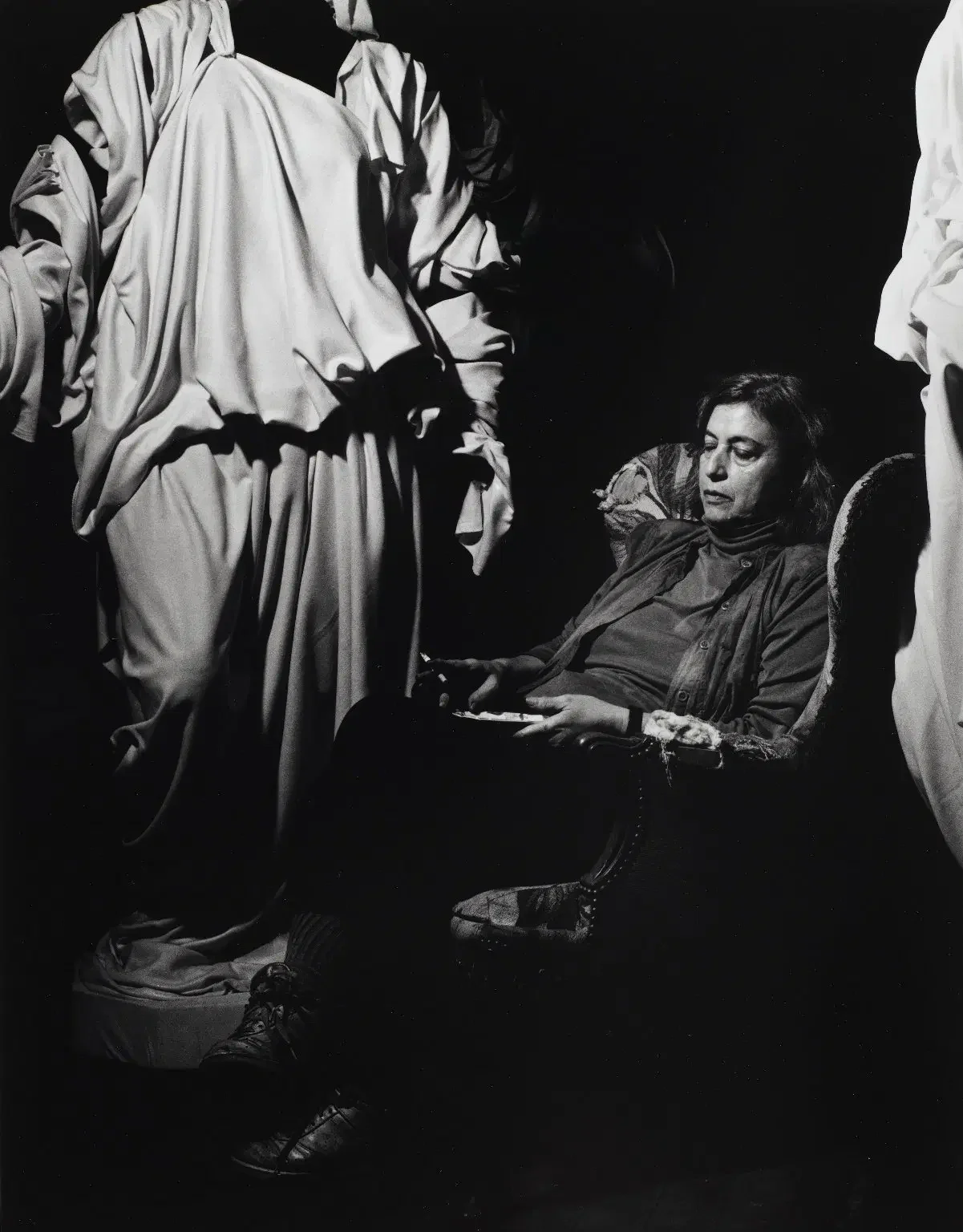
Muriel Castanis (1926–2006) was an American sculptor whose practice — developed across five decades in New York City — established a rigorously original body of work in postwar American art. Her work occupies a singular place at the intersection of classical figuration, feminist consciousness, and postmodern architectural ambition. Working primarily in cloth hardened with epoxy resin, Castanis produced figures of haunting formal authority: armless, headless, and faceless presences whose power derives entirely from the animate life of draped fabric. Her work occupies a position of sustained critical independence, resisting easy assimilation into the dominant movements of her era while anticipating the postmodern return to figuration, the feminist reclamation of craft and domestic material, and the renewed discourse around sculpture's relationship to architecture and public space.
Born in Greenwich Village, New York, in 1926, Castanis came to sculpture through painting and by accident — discovering, in the late 1960s, that epoxy-hardened cloth could hold the arrested energy of drapery in a way no prior medium had permitted her. Her earliest works transformed objects of domestic life — chairs, tables, bathtubs — into uncanny presences defined by the eloquence of what they concealed. By the mid-1970s, her practice had shifted decisively toward the human figure, arriving at the standing, robed forms that would define her mature work: hollow, bodiless, yet charged with an insistent vitality that critics and curators consistently described as classical in resonance and wholly contemporary in effect.
Castanis situated her work within the long history of drapery as a vehicle for meaning in Western sculpture, from Greek and Roman antiquity through the Renaissance and Baroque, while locating her particular innovation in the collapse of distance between illusion and material reality. Where the great carvers of the past rendered the suggestion of cloth in stone, Castanis worked with cloth itself — a material that retained its own history, its own memory of movement and use. The absence of the body, rather than marking a limitation, became the defining subject of her practice: void and presence held in permanent, unresolved tension. As she stated: "I feel my works are contemporary kin to the statues, those ruins of ancient times. From Greek and Roman gods, I skip to the Renaissance and use as a source any period where cloth and drapery were the main symbol in communicating heroic imagery."
Her Cleopatra's Needle series (begun 1977), incorporating needlework by anonymous and deceased craftswomen into pyramidal forms, represents one of the period's most sustained meditations on female labor, anonymity, and the suppression of creative identity within domestic life. The series anticipates concerns that would later become central to feminist art historical discourse, though Castanis arrived at them through the internal logic of her own material investigation.
Her first solo show, at O.K. Harris Gallery in SoHo, came in 1980. Career recognition arrived steeply thereafter. In 1982, architect Philip Johnson — drawn to what he described as a uniting of the classical and contemporary in her work — commissioned Castanis to create twelve monumental figural sculptures for the cornice of 580 California Street, a 23-story office tower in San Francisco's financial district designed by the firm of Johnson/Burgee. The project required the translation of her six-foot cloth-and-epoxy models into twelve-foot fiberglass castings capable of withstanding permanent outdoor installation at architectural scale. Completed in 1985, the commission stands as a landmark in the history of art and architecture's integration, cited as among the first instances of original figurative sculpture at heroic urban scale on a modern commercial building. The project was the subject of an exhibition and scholarly catalogue, Context and Collaboration for Contemporary Art: The Sculptural Program for 580 California Street, presented at Dickinson College in 1986.
By 1988, her Three Furies—exhibited at the American Craft Museum, New York—came to represent the full culmination of Castanis's figural vision. Life-sized, draped, faceless figures charged with furious forward energy, the figures invoke their mythological sources (Alecto, Tisiphone, Megaera, the avenging goddesses of Greek and Roman tradition). Installed on eight-foot steel pedestals and illuminated at night, they cast their silvery light across 53rd Street directly opposite MoMA.
Castanis received recognition relatively late by the standards of the postwar generation — a circumstance she shared with many women artists of her cohort, and one that her work, in its persistent engagement with absence, invisibility, and the suppression of identity, may be said to have addressed obliquely but with extraordinary consistency. Her figures endure as emblems of a particular kind of authority: one earned not through visibility but through the quality of sustained, uncompromising attention to the demands of a singular vision.
Castanis's work has been the subject of solo exhibitions at O.K. Harris Gallery, New York; the Carpenter Center for the Visual Arts, Harvard University, Cambridge (1985); Boulder Center for the Visual Arts, Boulder, Colorado (1989–90); and New York University, New York (2000), and has been included in significant group presentations including Standing Ground: Sculpture by American Women Artists, Contemporary Arts Center, Cincinnati (1987); Fashion is a Verb: Expanding the Definition, Museum at the Fashion Institute of Technology, New York (1995); and Everything's O.K. at O.K. Harris, Brevard Museum of Art and Science, Melbourne, Florida (2003). Her work is held in public, institutional, and private collections internationally, including a permanent commission for the Flatbush Avenue–Brooklyn College subway station, New York, and has been the subject of sustained critical attention in the New York Times, Arts Magazine, American Craft, and Women Artists News, among other publications.
Castanis lived and worked in Greenwich Village for her entire life. She died there on November 22, 2006, at the age of eighty.